AudioCodes
con4PAS has become the AudioCodes Channel Partner with the certification:
Registered VAR / Systems Integrator


con4PAS has become the AudioCodes Channel Partner with the certification:
Registered VAR / Systems Integrator

Enterprise AI is moving beyond assistants embedded in individual applications. SAP's AI-Native North Star Architecture describes a more fundamental shift: from systems that record business events to systems that can also understand context, learn from interactions, and act across the enterprise. The practical message for leaders is straightforward. The value of AI will depend less on the model itself and more on the quality of the data, process knowledge, governance, and business context around it.
From a system of record to a system of context
Enterprise software has spent decades becoming very good at recording facts. It stores transactions, applies rules, and shows what happened. What it often cannot explain is why a decision was made, which alternatives were considered, or what worked in a similar case. That reasoning remains distributed across people, applications, process histories, and individual interactions. SAP's AI-native vision connects these elements into a system of context. Instead of working with isolated data, AI agents can draw on business data, process knowledge, decision history, and shared semantics. Their recommendations can therefore reflect how the company actually operates, not just what one application can see.
Why adding AI features is not enough
The first wave of enterprise AI has largely followed an AI-first model: useful capabilities added to existing applications. An assistant may summarize an invoice, draft a response, or recommend a next step. The benefit is real, but the application boundary remains. SAP illustrates the limitation with a supplier case. An application may identify an overdue invoice without seeing related service disputes, delayed shipments, or a renegotiated procurement contract. This is the difference between a smart feature and an enterprise capability. AI-first improves a local task. AI-native changes the foundation so that governed agents can coordinate across systems, processes, and business domains.
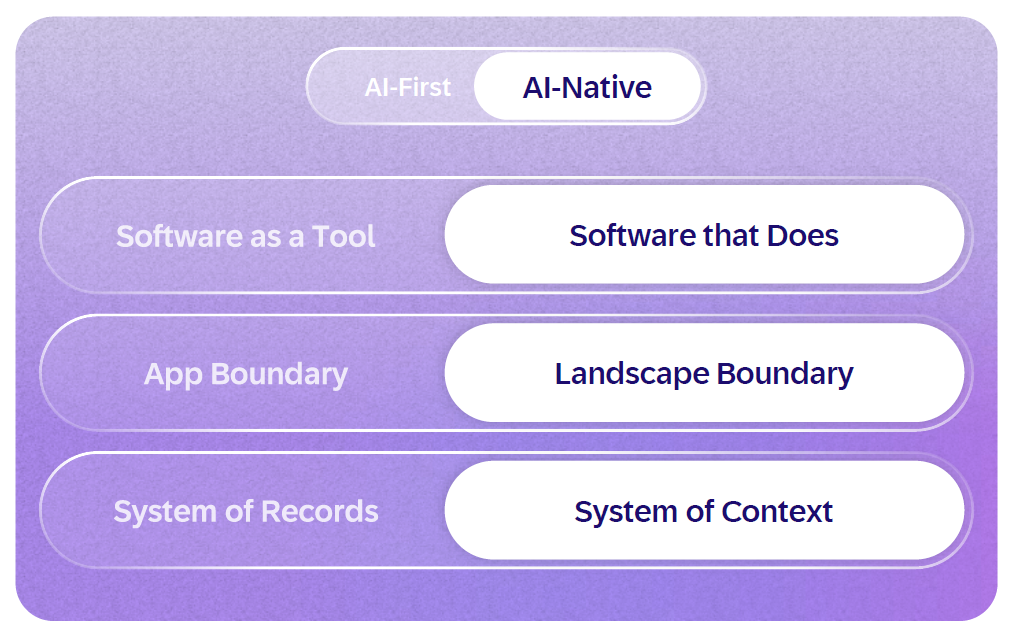
Pic.: AI-First to AI-Native
Business intent becomes the starting point
The change is easiest to see in the way work begins. Today, users typically open an application, search for data, interpret the situation, and trigger the required action. In an AI-native model, the user expresses an intent and the system brings together the relevant experience, data, agents, and actions. SAP positions Joule as the engagement layer, with agents working across finance, spend, supply chain, human capital, and customer experience. This does not remove people from the process. It moves routine coordination to governed automation while keeping human responsibility where it matters: direction, judgment, exceptions, and high-impact decisions.
Context is the differentiator
This is why the North Star Architecture matters beyond the architecture team. Leading AI models are increasingly available to many providers, so access to a model alone is unlikely to remain a lasting advantage. The differentiator is the context the model can use safely: process definitions, data products, business rules, previous decisions, exceptions, approvals, and company-specific knowledge. SAP Business Data Cloud and SAP Knowledge Graph are presented as key parts of this foundation, connecting data with business meaning. In practice, enterprise AI must do more than produce a fast answer. It needs to understand what a customer, supplier, contract, order, dispute, or risk means in that company's landscape.
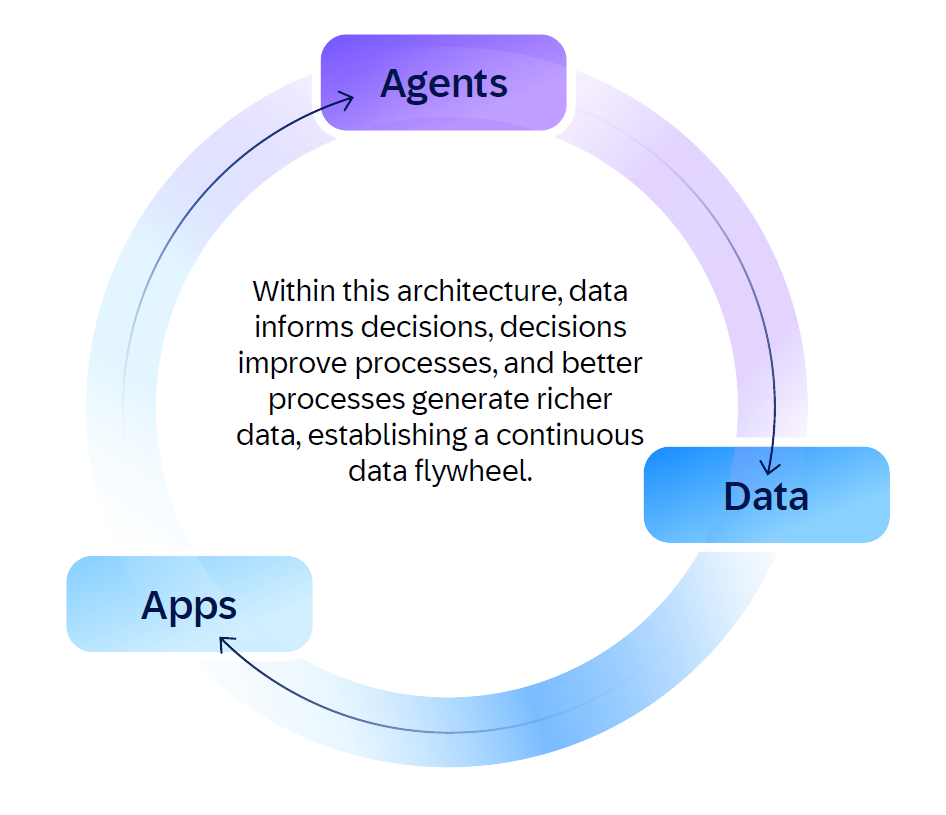
Pic.: Data Flywheel
Governance makes autonomy usable
Agents can create business value only when the organization can trust how they operate. The architecture therefore treats identity, access control, observability, auditability, guardrails, and human-in-the-loop controls as core capabilities. Agents become enterprise actors with defined identities, permissions, and boundaries. They may act, but only within explicit policies and with clear accountability. For management, the implication is important: governance is not an obstacle to AI adoption. It is the condition that allows AI to move from recommending actions to executing parts of real business processes safely. Without trust, agents can advise. With trust, they can operate.
What should business leaders do now?
SAP explicitly describes the North Star paper as a strategic direction, not a product roadmap or a commitment to specific capabilities or timelines. The sensible response is therefore not to wait for one decisive product release. Companies can already prepare for a different operating model: identify where value is lost between systems, improve data quality and ownership, define where human approval remains essential, and measure AI through business outcomes rather than the number of deployed features. Organizations will gain more from this shift when they treat AI as a change in how work is coordinated, governed, and improved - not as another tool added to the existing landscape.
Start with context, not the model
The central idea of SAP's AI-native vision is simple: a powerful model is not enough for enterprise AI. Reliable agents also need governed data, business context, process understanding, and a platform that can operate them at scale. This reframes the decision for business leaders. The first question should not be which AI tool to buy. It should be whether the organization has the data, governance, and process maturity required for AI to act responsibly. In the next phase of enterprise software, context may matter more than individual features - and trusted business outcomes more than access to another application.
Sources:
Interested in the article and want to know more? |