AudioCodes
con4PAS has become the AudioCodes Channel Partner with the certification:
Registered VAR / Systems Integrator


con4PAS has become the AudioCodes Channel Partner with the certification:
Registered VAR / Systems Integrator

Lead-to-cash is the end-to-end path from first contact to booked revenue - and in B2B it is rarely simple. Long deal cycles, multiple stakeholders, and constant change make it easy for customer information, pricing, inventory status, and approvals to drift out of sync. SAP’s briefing “Assembling intelligent lead-to-cash processes with AI” argues that the fastest way to improve deal velocity is to connect every stage of the process and embed intelligence into daily work. When sales, marketing, finance, and operations act on the same data, teams reduce guesswork, respond faster, and deliver a more consistent customer experience.
Why lead-to-cash matters beyond revenue
An effective lead-to-cash process is not just a sequence of internal steps. It is the customer’s journey—from initial interest to delivery and payment. When execution is connected and streamlined, companies do more than close deals: they improve operational efficiency and elevate the overall customer experience. That requires continuous collaboration across sales, marketing, finance, and operations so that customer needs and internal commitments remain aligned at every point in the cycle.
From disconnected steps to a dynamic, intelligence-driven process
B2B selling often involves long cycles and unique stakeholder requirements. To earn trust, sellers must understand each customer’s needs, challenges, and industry context. The briefing highlights a practical approach: connect the lead-to-cash systems and embed intelligence so the platform can analyze large volumes of data, detect patterns, and make predictions faster and more accurately than manual methods. When the underlying process is connected, teams can keep messages consistent across interactions, exchange dependencies quickly, and adapt to buyer requirements in real time—without breaking process links or disrupting workflows.
The lead-to-cash blueprint: five stages, one connected flow
The document outlines lead-to-cash as a connected execution blueprint. The key is continuity: signals captured early (campaign engagement, sentiment, timeline, risks) should travel forward and improve how opportunities are prioritized, how quotes are built, and how orders are fulfilled. The stages are presented as a single flow rather than isolated handoffs:
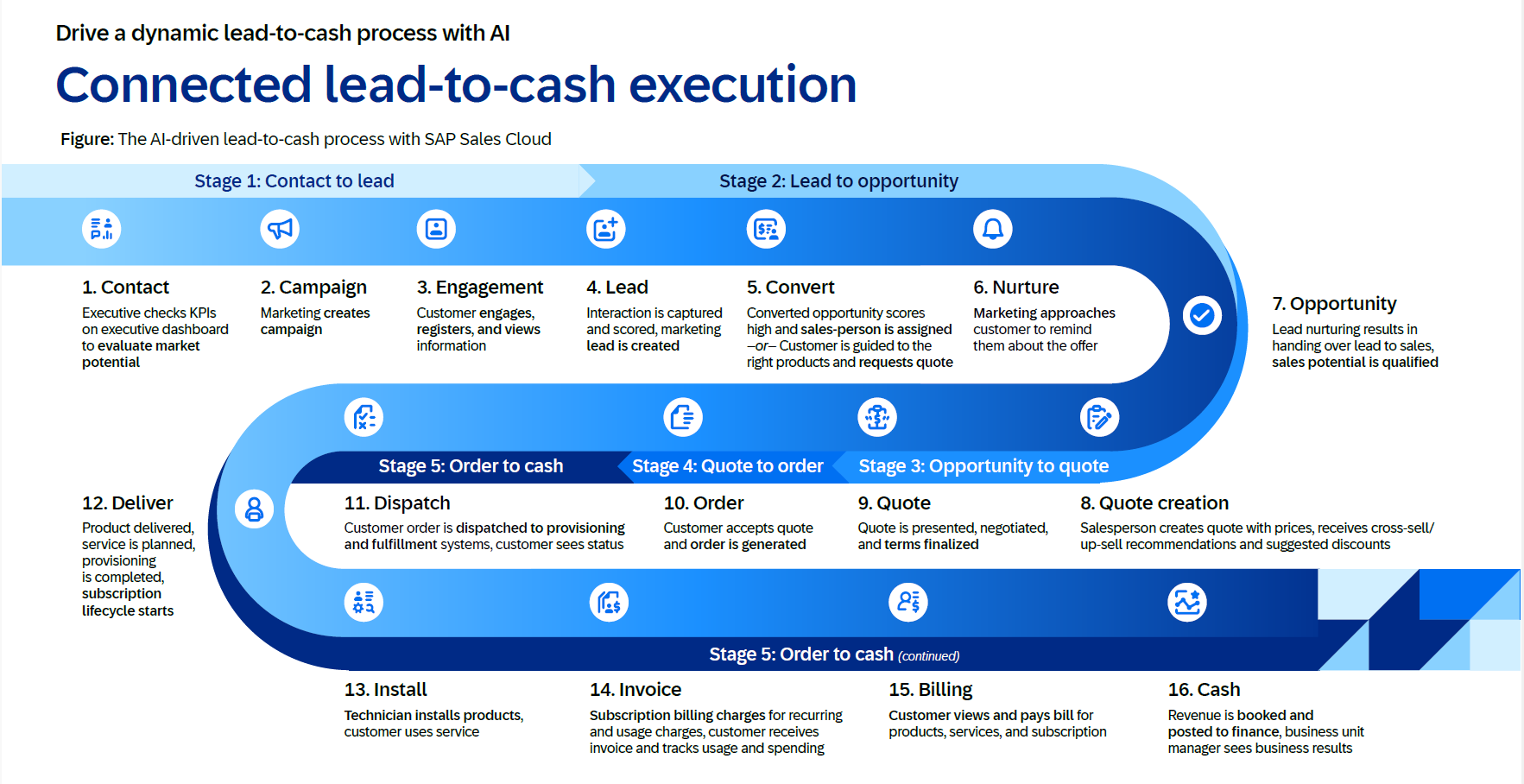
Stage 1–2: qualify the right leads and engage smarter
The first stages focus on turning contacts into qualified revenue potential. Campaigns work best when outreach matches a prospect’s challenges, values, and mindset, supported by connected business and third‑party data. As engagement starts, enriched lead data builds a more complete view of each prospect. When leads move toward opportunity, predictive scoring and routing help teams prioritize what is most likely to close, while lower‑priority leads can be nurtured for long‑term development. The result is simple: sales teams spend more time on the right conversations and less time managing noise.
Stage 3–4: move opportunities forward with guided selling and pricing discipline
As opportunities progress, sellers must address objections and deliver accurate proposals tailored to multiple stakeholders. The briefing describes practical support across this stage: opportunity scoring to focus sellers, guided selling to recommend next-best actions, and stronger intra-team alignment through shared visibility. When deals move to quote and order, configuration and pricing become critical. Intelligent CPQ workflows help ensure required items are included, highlight upsell paths, and support pricing decisions by considering historical discount behavior, market signals, and target margins. Connecting to back-office signals—such as delivery timelines and available-to-promise inventory—helps sellers set expectations early and reduce late-stage surprises.
Stage 5: turn orders into cash with fewer errors and better service
After an order is confirmed, execution shifts to fulfillment, installation, billing, and revenue recognition. Here, the document emphasizes operational synchronization: one updated view of the customer account supports more productive interactions in the future. Predictive analytics can suggest next purchases, pricing can be optimized based on purchase history and market context, and automation can flag issues such as missing information or incorrect pricing before they create downstream delays. The outcome is a smoother cash cycle and stronger customer satisfaction because the business can proactively resolve issues and set clear expectations.

Bringing it together with SAP Sales Cloud
The closing message is straightforward: an intelligent lead-to-cash process helps companies increase efficiency, accelerate deal velocity, and overcome objections with data-driven strategies. SAP Sales Cloud positions this capability as an integrated way to guide actions and improve outcomes throughout the sales process—connecting data across departments and enabling consistent customer-focused execution from lead to cash.
Source: Assembling intelligent lead-to-cash processes with AI (SAP Sales Cloud).
Interested in the article and want to know more? |