AudioCodes
con4PAS has become the AudioCodes Channel Partner with the certification:
Registered VAR / Systems Integrator


con4PAS has become the AudioCodes Channel Partner with the certification:
Registered VAR / Systems Integrator

Artificial intelligence is moving quickly from experimentation to everyday use in customer communications. But widespread adoption does not automatically mean widespread trust. Sinch’s 2025 analysis asks a practical question: are businesses and consumers equally ready to let AI shape support, service, and engagement? The answer is nuanced. Companies are investing heavily, but customer trust still depends on context, age group, use case, and how well AI improves the experience rather than simply reducing costs.
AI is already becoming standard in customer communications
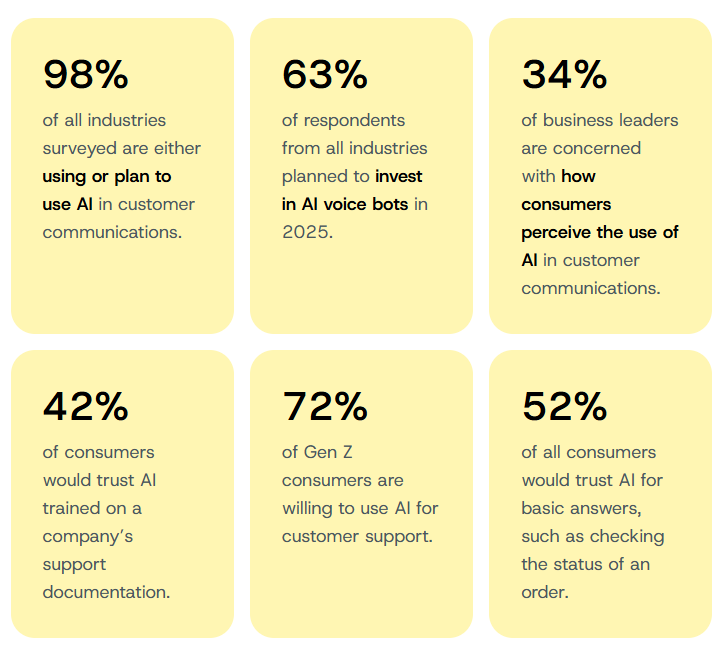
The article shows that enterprise adoption is no longer theoretical. Across healthcare, retail, technology, and financial services, 98% of surveyed business leaders said they are already using AI in customer communications or plan to do so. That level of adoption suggests the market has moved beyond “if” and toward “how.” Businesses are not waiting for every customer to feel comfortable before moving ahead. Instead, they are building the infrastructure, workflows, and communication strategies that will support much broader use of AI in the near future. The article also notes that AI solutions ranked among the top emerging communication technologies for 2025, which underlines just how quickly this shift is becoming mainstream.
Investment is accelerating where automation can reduce friction
One of the clearest findings is where businesses are placing their bets. In 2025, 63% of surveyed companies planned to invest in AI voice assistants, while 46% were adopting or investing in AI-driven chatbots. More than a third, 35%, said AI and automation were already part of their strategic communications investments. This matters because businesses are not only looking for smarter responses. They also need reliable delivery, secure handling of data, and systems that connect with the rest of their communication stack. In practice, that means AI investments increasingly depend on the quality of the infrastructure behind them.
Trust still depends on the use case
Businesses may be moving fast, but consumers are more selective. According to the article, 42% of consumers would trust AI trained on a company’s support documentation, and 52% would trust it for basic tasks such as checking an order status. That suggests a practical trust boundary: people are more open to AI when the task is straightforward, predictable, and easy to verify. More complex or emotionally sensitive interactions still require more caution. This is a useful lesson for companies: trust grows faster when AI starts with simple, low-risk tasks and proves its value over time.
Customer support is a strong use case—but not a universal first choice
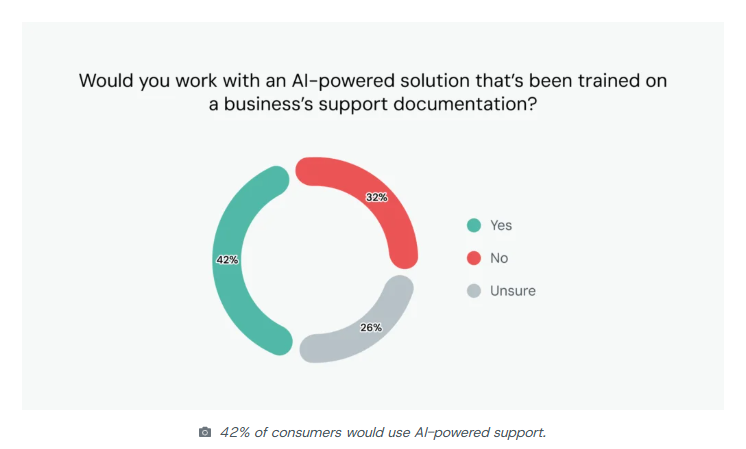
Support remains one of the most common and practical ways to use AI. The article notes that 42% of consumers are willing to use AI-powered support, while 32% would not, and another 26% are still unsure. At the same time, only 5% picked AI chatbots as their first-choice support option, while email, live chat with an agent, and voice calls still ranked higher. The message is clear: AI can absolutely improve support, but it works best when it expands customer choice rather than replacing it. The companies that build trust will be the ones that use AI to shorten wait times and handle routine issues while making it easy to reach a person when needed.
Generational differences matter more than many brands expect
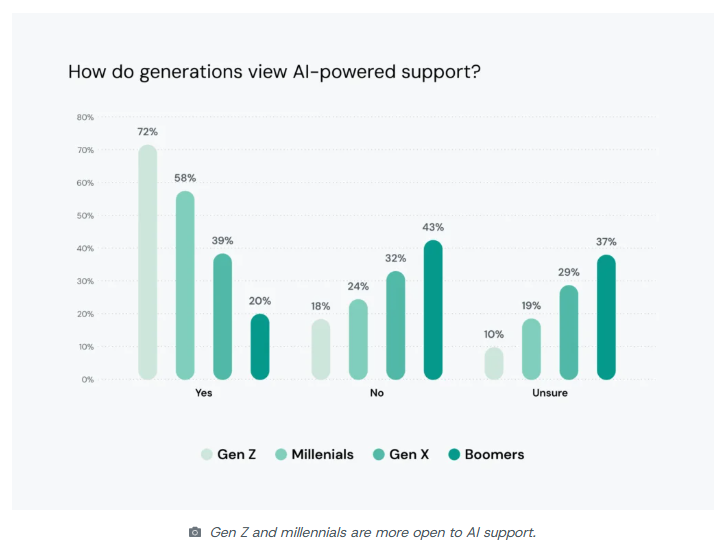
The article also highlights a major divide between age groups. Younger consumers are much more comfortable using AI in support scenarios: 72% of Gen Z respondents and 58% of millennials said they are open to AI for customer support. That falls to 39% for Gen X and just 20% for baby boomers. For brands, this means one-size-fits-all communication strategies will not be enough. Trust in AI is partly a demographic issue, so the right mix of channels, automation, and human fallback will vary depending on who the customer is.
Trust is built through experience, not just technology
The most important conclusion in the article is not about the tools themselves. It is about customer experience. Sinch argues that businesses should use AI to improve convenience, speed, and consistency—not to hide from customers or force automation where it does not belong. That means choosing use cases carefully, keeping satisfaction as the guiding measure, and knowing when a conversation should move to a human agent. AI can strengthen communications, but trust is earned only when customers feel the result is genuinely helpful.
Source: Sinch blog: “Are we ready to trust in AI to power the future of customer communications?” (December 11, 2025).
Interested in the article and want to know more? |