AudioCodes
con4PAS has become the AudioCodes Channel Partner with the certification:
Registered VAR / Systems Integrator


con4PAS has become the AudioCodes Channel Partner with the certification:
Registered VAR / Systems Integrator

Companies want to move faster, become more digital, and respond better to change. Yet everyday work is still slowed by processes that break at departmental boundaries. IDC's white paper explains why enterprise service management is expanding beyond IT and becoming a practical operating model for the wider business. When requests, workflows, data, and approvals are connected across functions, organizations can remove friction, improve the employee experience, and build a stronger foundation for intelligent automation.
From the IT service desk to an enterprise service model
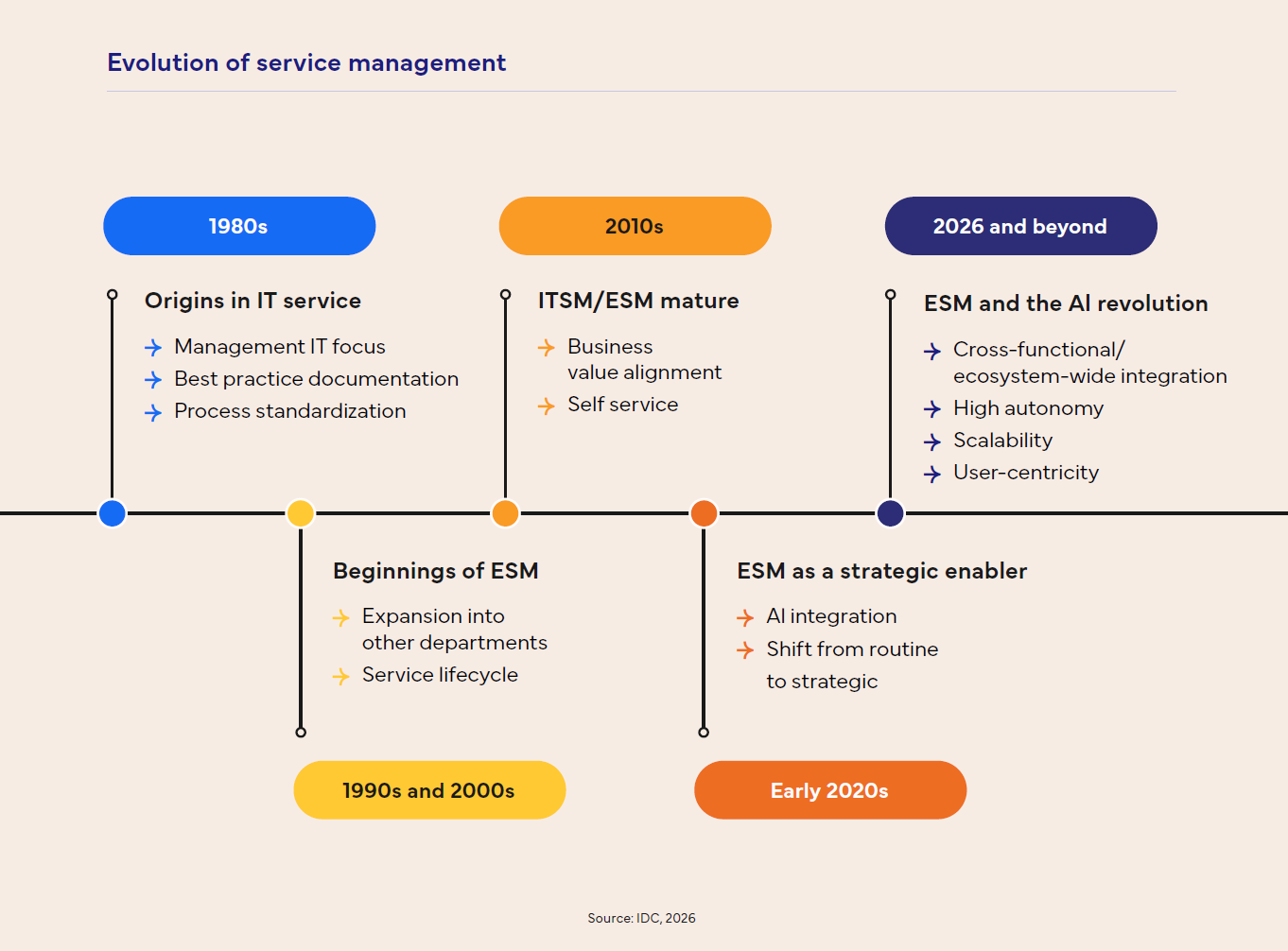
Service management began in IT, where teams needed a structured way to receive requests, resolve incidents, restore services, and document repeatable processes. The same principles now address similar problems across HR, finance, procurement, legal, facilities, customer service, and supplier management. Requests arrive through different channels, approvals are fragmented, data sits in separate systems, and employees often cannot see where a process stands. Enterprise service management extends proven service practices across these functions. It gives the business a consistent way to handle requests, automate routine steps, assign ownership, and manage the full journey from inquiry to resolution.
Why ESM belongs on the management agenda
The management case for ESM is not about technology alone. It is about reducing cross-functional friction. A straightforward employee request may involve a manager, IT, finance, procurement, and sometimes HR or legal. Without a shared service model, handovers become slow, ownership is unclear, and no one sees the complete process. Nearly 70% of organizations surveyed by IDC had moderately or fully implemented ESM, confirming that the model has moved beyond early experimentation. The reasons are practical: faster responses, fewer manual handovers, better visibility, and more consistent service delivery across the enterprise.
Business value is measurable
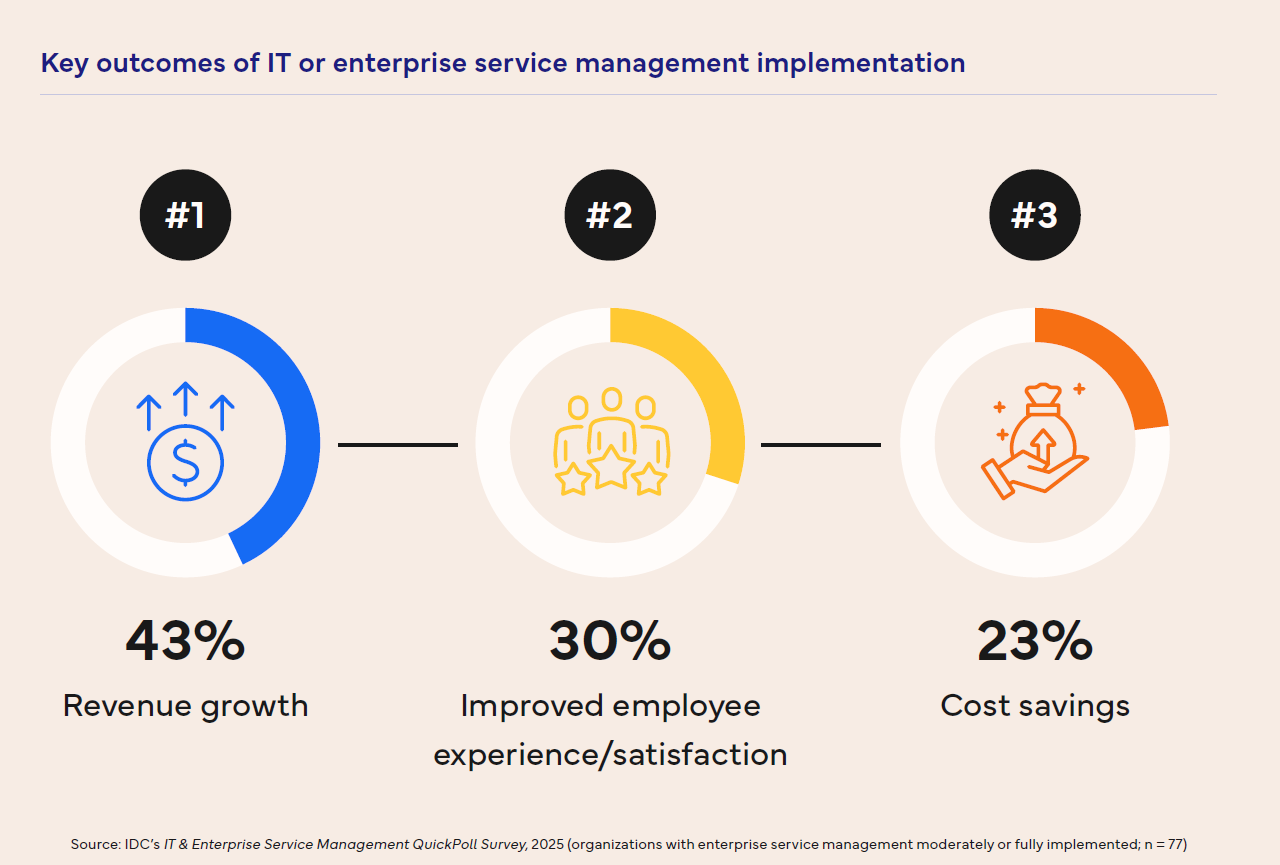
IDC's findings make the case tangible. Among organizations with ESM moderately or fully implemented, 43% reported faster incident resolution, 35% reported employee time savings across the organization, 27% reported improved processes, and 27% reported faster responses to requests. The outcomes also extend beyond efficiency. Revenue growth was cited by 43% of ESM implementers, improved employee experience or satisfaction by 30%, and cost savings by 23%. ESM should therefore not be discussed only as a cost-reduction tool or a back-office workflow system. Implemented well, it becomes a platform for better service, higher productivity, and business growth.
A shared platform improves handovers between teams
ESM creates value by connecting work across business functions. IDC lists frequent integrations with ERP, finance and procurement systems, HR software, customer service tools, enterprise asset management, portfolio management, legal software, and IT operations. These connections matter because business outcomes often depend on the handovers between teams, not on the performance of one team in isolation. A finance request, supplier onboarding, contract review, or payroll correction may pass through several systems and owners. ESM provides a shared service layer, a consistent view of progress, and a better flow of data across the value stream. Delays become easier to identify, and improvements easier to manage.
A practical foundation for intelligent automation
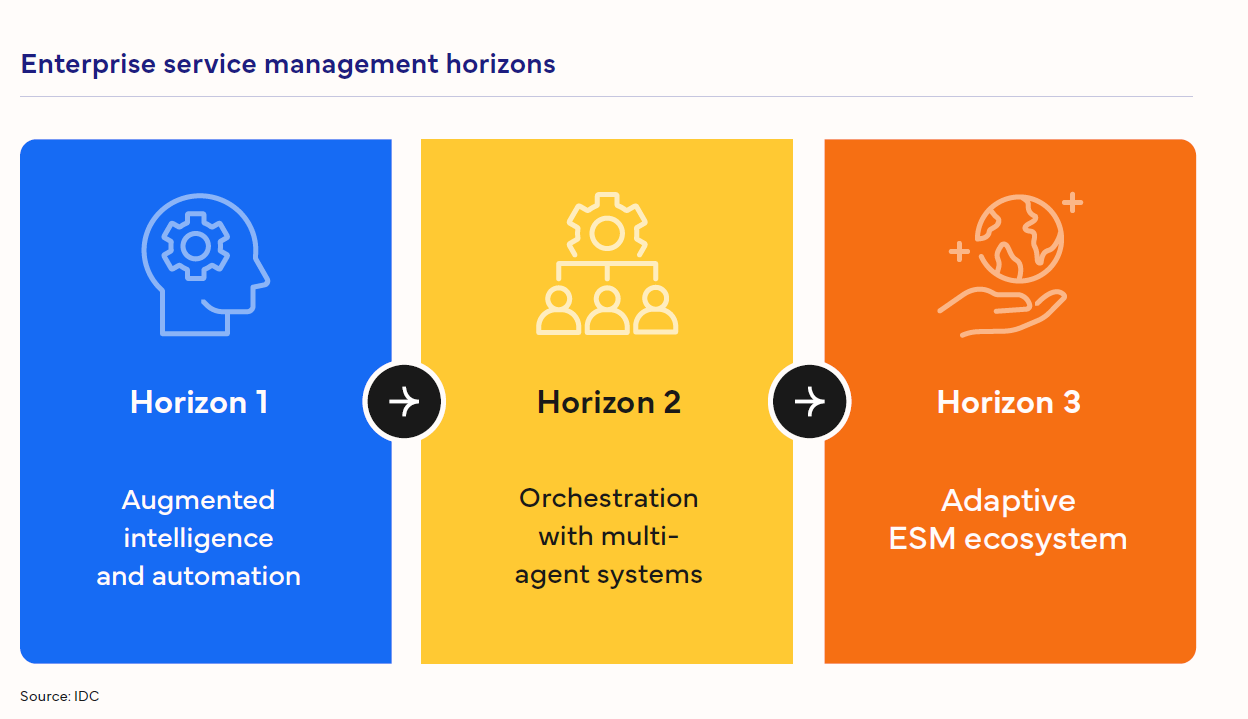
IDC also links ESM to the next stage of automation and AI. The change is gradual, not an overnight replacement of people by autonomous systems. First, AI supports employees through search, recommendations, virtual agents, and routine task automation. Later, multiple agents may coordinate more complex workflows. Over time, ESM can develop into a more adaptive ecosystem that learns from service patterns and helps improve processes. This is why ESM matters for AI readiness. An organization cannot automate a process it does not understand, or safely delegate work to agents when its data, access rights, governance, and process ownership are unclear. ESM helps put those foundations in place.
Integration and change management remain the hard part
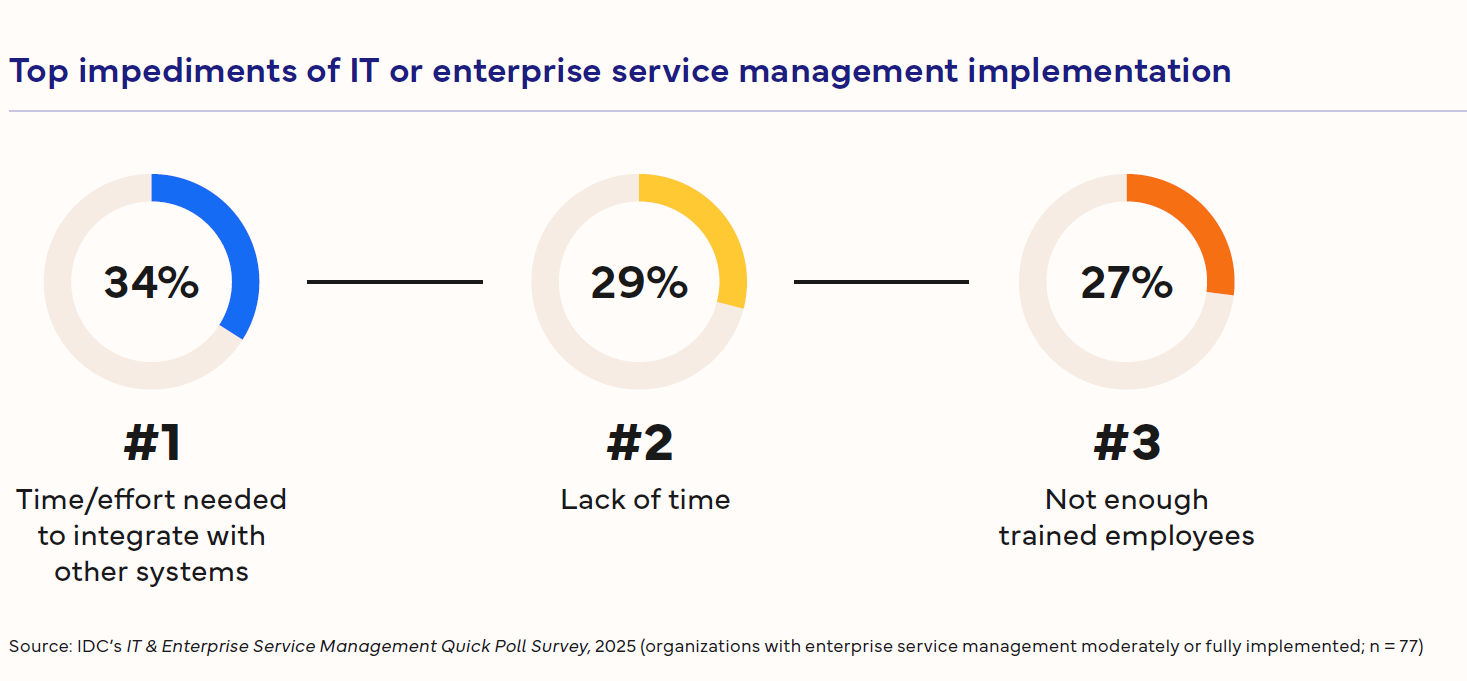
IDC is equally clear about the implementation challenges. As ESM adoption matures, integration becomes more demanding. Among organizations with ESM moderately or fully implemented, 34% cited the time and effort required to integrate other systems as the leading impediment. Lack of time followed at 29%, while 27% pointed to a shortage of trained employees. The numbers keep the business case realistic. ESM can deliver substantial value, but it is not simply a software deployment. Success requires integration capabilities, clear process ownership, measurable outcomes, employee training, and an operating model that balances automation with human contact.
Less friction creates more business value
Enterprise service management addresses a familiar problem in every growing organization: work gets stuck between departments. A shared service model, common workflow layer, and end-to-end visibility can reduce that friction and improve the experience of employees, suppliers, partners, and customers. The value increases further as organizations prepare for intelligent automation. The strongest results will come from treating ESM as a business operating model for faster, more transparent, and better-connected work - not as another IT project.
Source: IDC White Paper, “Enterprise Service Management: Modernizing Business by Easing Cross-Functional Friction,” June 2026.
Interested in the article and want to know more? |