AudioCodes
con4PAS has become the AudioCodes Channel Partner with the certification:
Registered VAR / Systems Integrator

con4PAS has become the AudioCodes Channel Partner with the certification:
Registered VAR / Systems Integrator

What looked like an ambitious product promise in late 2025 has now become a live market shift. SAP’s first next-gen SAP Ariba release launched in February 2026, and the rollout has continued through 2026, with SAP Ariba Intake Management now presented as globally available. That makes this story more important than a typical product upgrade. SAP is not just adding more automation to an existing Source-to-Pay suite. It is rebuilding the platform around a new architecture, a unified experience, and embedded intelligence designed to reduce friction across procurement.
This is a platform rebuild, not a cosmetic refresh
The most important thing to understand is that next-gen SAP Ariba is not being positioned as a feature pack or a visual cleanup. SAP has rebuilt the platform on SAP Business Technology Platform, using a shared data foundation and open APIs to improve interoperability with SAP S/4HANA and other systems. That is a big architectural shift for a suite of this size. It matters because many procurement platforms still carry the weight of fragmented modules, uneven user experiences, and data that does not move cleanly across the full Source-to-Pay process. A rebuild of this kind is SAP’s way of trying to remove those old limits instead of continuing to patch around them.
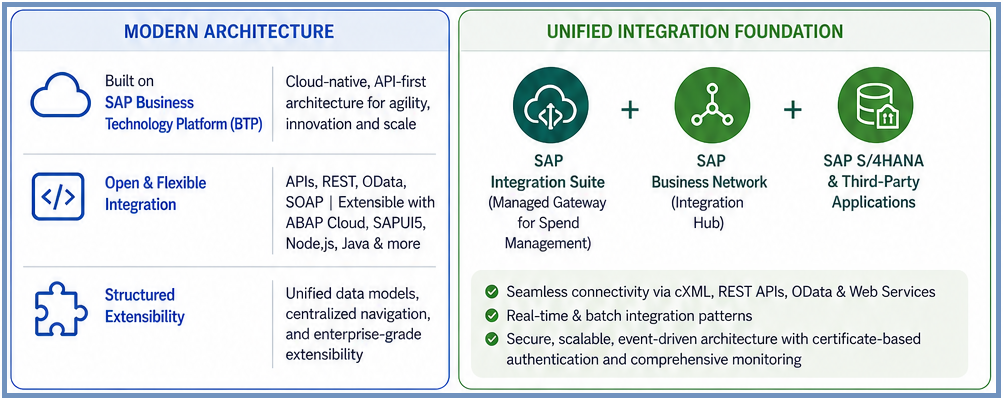
Pic.: Next-gen SAP Ariba Architecture & Integration Foundation
The first release is already live, and SAP is using it to reset expectations
The first release was already launched in February 2026, and the next-gen capabilities are being delivered in phases through 2026 and into 2027. That means the conversation has already moved on from whether the release will happen. The real question is how much practical value SAP can deliver as adoption grows. For procurement leaders, this changes the tone of the announcement. It is no longer a forward-looking promise only. It is now an active rollout that customers can evaluate in the market and in real projects.
The strongest early signal is the move toward a unified procurement experience
One of the clearest practical changes is SAP Ariba Intake Management, which SAP now describes as globally available. That matters because procurement often still feels fragmented for business users. Requests start in one place, approval paths continue somewhere else, and the process becomes harder to follow the moment a casual stakeholder enters the flow. By positioning intake management as the front door for procurement requests and combining it with a Fiori-based launchpad, SAP is trying to create a simpler and more coherent user experience across the suite. If that works well in practice, it could remove one of the oldest frustrations in enterprise procurement: too many entry points, too many handoffs, and too little visibility.
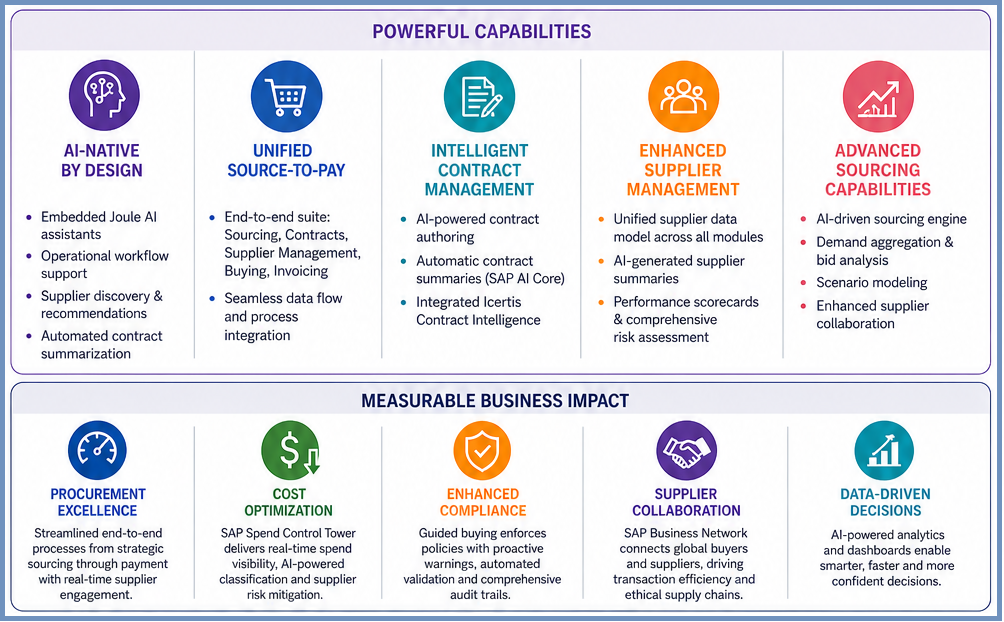
Pic.: Next-gen SAP Ariba - Capabilities & Business Impact
Embedded intelligence is the bigger strategic bet
The long-term significance of next-gen SAP Ariba is not just the interface. It is the attempt to make intelligence part of the operating model of procurement. SAP has highlighted Joule-supported capabilities such as bid analysis, supplier-response summaries, and more intelligent contract work, while also presenting the platform as a foundation for more autonomous workflows over time. That is a more meaningful shift than simply placing an assistant on top of old processes. Procurement teams do not need extra screens full of recommendations they cannot act on. They need faster analysis, better decisions, and less friction inside the actual workflow. The success of next-gen SAP Ariba will depend on whether those embedded capabilities become genuinely useful in day-to-day sourcing, contracting, and purchasing work.
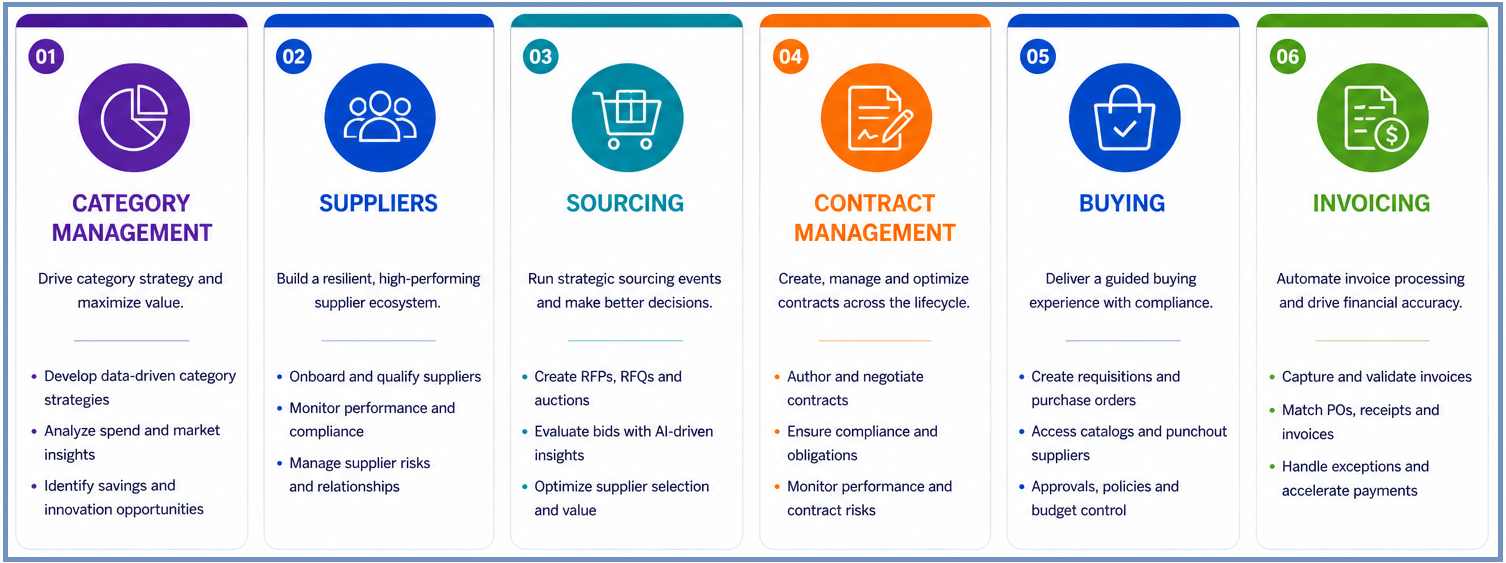
Pic.: Next-gen SAP Ariba - 6 Solution Areas
Why this matters to current customers
For existing SAP Ariba customers, the rebuild is strategically important because it may lower the cost of standing still. SAP has said that customers can adopt next-gen capabilities without a new contract, with transition support from SAP and its partners. That makes the move easier to view as a managed evolution rather than a disruptive reimplementation. It also gives current customers a reason to pause before making a platform switch elsewhere, because the next phase of SAP Ariba is no longer theoretical. The better SAP executes the migration path, the more powerful that argument becomes.
The market impact could be bigger than the product launch itself
Ardent Partners argued in late 2025 that this rebuild could become a catalyst for the wider procurement technology market, and that point still holds. The reason is simple: SAP Ariba sits at such a scale that a credible architectural reset changes expectations for the whole category. Competitors can no longer rely only on being faster or more modern than an aging incumbent if that incumbent is now rebuilding around shared data, open connectivity, and a more unified experience. At the same time, SAP still has to prove that scale and vision can turn into usability, adoption, and measurable business value. That proof will decide whether next-gen SAP Ariba becomes a market milestone or simply a very ambitious transition.
A shorter conclusion: now the real work begins
The most interesting part of this story is that the launch phase has already started. That makes this less a story about future ambition and more a story about execution. SAP has put a bold idea into motion: rebuild Source-to-Pay around a cleaner architecture, a better front door, and embedded intelligence that helps procurement act faster. If those pieces come together in a way customers can use without adding complexity, next-gen SAP Ariba could become one of the more consequential procurement platform shifts of this cycle. If not, it will remain an important signal of where the market expects procurement software to go next.
Sources:
Download the full report below.
Interested in the article and want to know more? |