AudioCodes
con4PAS has become the AudioCodes Channel Partner with the certification:
Registered VAR / Systems Integrator

con4PAS has become the AudioCodes Channel Partner with the certification:
Registered VAR / Systems Integrator

SAP Business Network began as infrastructure for exchanging purchase orders, invoices, confirmations, and shipping notices between buyers and suppliers. Ardent Partners argues that its next phase is more ambitious: a shared operational layer where data, workflows, and AI agents can coordinate work across procurement, supply chain, finance, HR, customer experience, and eventually company boundaries. The opportunity is substantial, but it will depend on execution, data quality, governance, and the willingness of trading partners to participate in a different kind of network.
A network that has changed before
The evolution of SAP Business Network is easier to understand when viewed as a series of pivots. The original Ariba Supplier Network was built during the first wave of B2B internet platforms, then shifted toward applications that helped companies source, contract, order, and collaborate with suppliers. Its move to the cloud created the scale and transaction infrastructure that later became a major differentiator for SAP Ariba. Ardent Partners describes the current move toward AI-first operations as a third pivot of comparable importance. The network is no longer being positioned only as a channel for transactions, but as a foundation for coordinating decisions and work across a much broader business ecosystem.
The architecture changes what the network can become
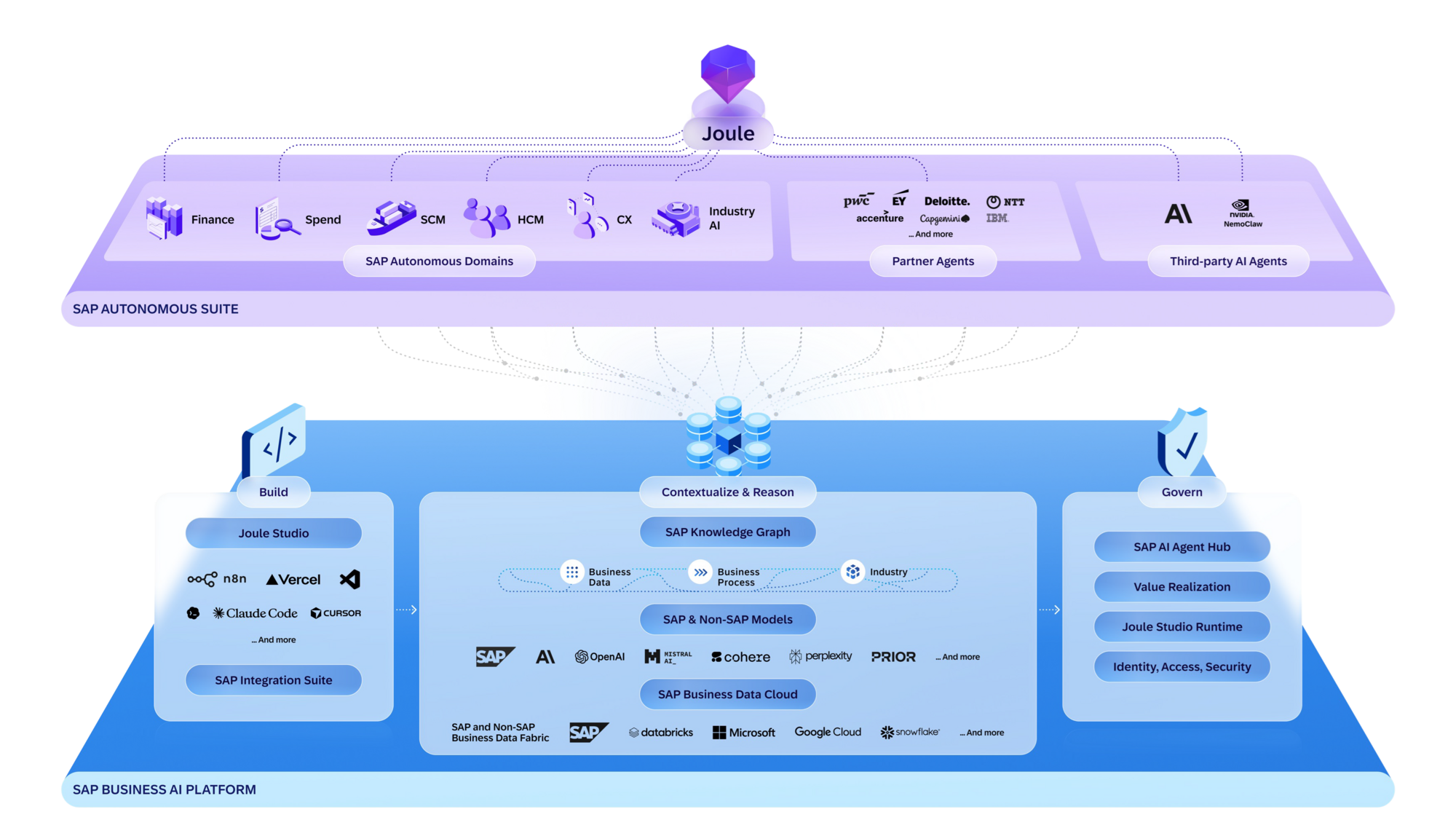
The transformation rests on three connected layers. SAP Business Technology Platform provides integration, workflows, analytics, security, identity, and extension services across the SAP portfolio. SAP Business Data Cloud adds a shared semantic model for business objects such as suppliers, contracts, purchase orders, invoices, shipments, inventory, financial commitments, and workforce data. Joule and the emerging agent layer are intended to use that context to coordinate actions across applications. In our earlier article on SAP's AI-Native North Star Architecture, we highlighted that a powerful model is not enough; enterprise AI also needs governed data, process knowledge, and business context. The Business Network shows how that principle could be applied to real interactions within and between companies.
Agents will expand in stages
Ardent Partners expects agentic adoption to develop in three stages. The first is automation within a single function, where agents support procurement, supply chain, or finance teams with routine work and operational exceptions. The second introduces cross-functional orchestration, allowing agents to connect procurement commitments, supply constraints, and financial impact within one execution loop. The third, more forward-looking stage extends coordination beyond the enterprise, with buyer-side and supplier-side agents working across the Business Network on sourcing, fulfillment, and settlement. This progression is credible precisely because it is gradual. Each stage requires stronger data consistency, clearer authority, more mature processes, and greater trust before agents can take on broader responsibility.
Procurement and supply chain provide the first practical use cases
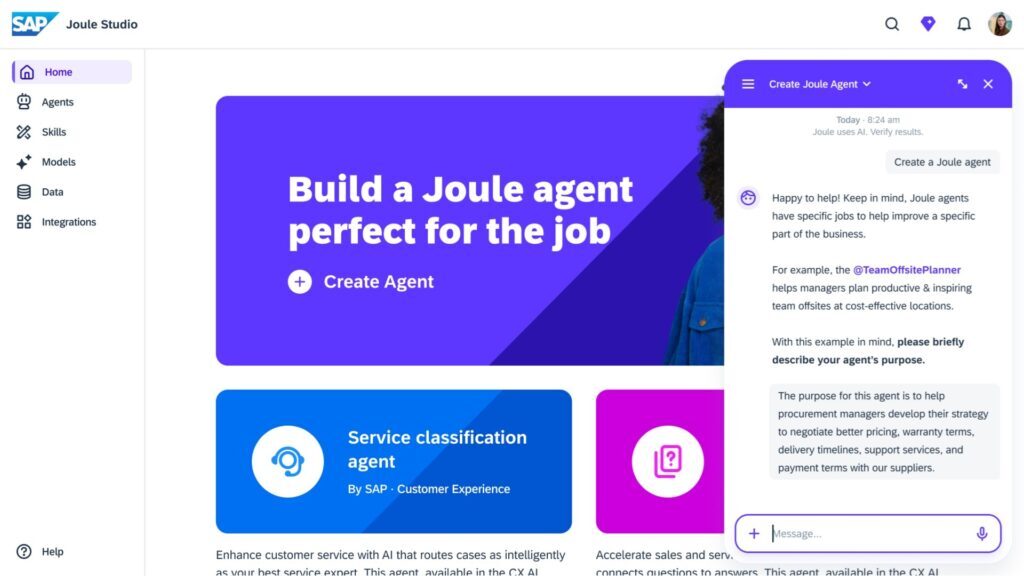
Supplier onboarding illustrates the near-term value. The process typically spans several teams, applications, approvals, checks, and data sources, which makes it slow and difficult to monitor. SAP positions the Supplier Onboarding Agent as a way to coordinate these steps dynamically across the Business Network and adjacent applications. Similar procurement agents are being developed for bid analysis, supplier evaluation, contracting support, spend visibility, and compliance monitoring. In supply chain management, the longer-term ambition is to connect external disruption signals with internal planning and recommend responses such as reallocating inventory, finding alternative suppliers, or adjusting production. These examples are useful because they turn the architecture into recognizable business processes, while also showing that broader autonomous execution still depends on organizational readiness.
A connected suite offers context, not automatically clean data
SAP's advantage in the agentic era may come less from any individual application and more from the coherence of its suite. Shared business objects and process logic can allow work initiated in SAP Ariba, S/4HANA, IBP, Fieldglass, SuccessFactors, or another SAP application to continue without being reinterpreted at every system boundary. That provides agents with a broader and more consistent operating context than isolated tools can usually offer. But the Ardent report makes an important distinction: a unified semantic model does not automatically create clean or harmonized enterprise data. Large SAP environments often contain decades of custom configurations, inconsistent master data, and different levels of process discipline. The architecture provides a structure for consistency; each organization still has to make its data usable.
Market interest is strong, but execution will decide the outcome
Interest in agentic procurement is already high. Ardent Partners reports that more than 65% of procurement organizations plan to introduce agentic capabilities within the next two to three years, while SAP's roadmap includes more than 30 agents across procurement and supply chain workflows. Those numbers indicate momentum, not guaranteed adoption. The relevant measures will be how many agents reach production maturity, how reliably they operate, and where human intervention remains necessary. The market should also watch the migration of large and customized customers to BTP, the commercial packaging of cross-suite AI capabilities, and the depth of supplier participation. A business network becomes more valuable when suppliers engage with it as an intelligence and collaboration channel, not merely as a transaction requirement.
The next step is to prepare the operating foundation
SAP is attempting to move Business Network from transaction infrastructure to an operating layer for internal coordination and external trade. If the transformation succeeds, companies could connect decisions across procurement, supply chain, finance, workforce, and partner ecosystems with less manual coordination and better context. The direction is convincing, but the outcome will not be determined by architecture diagrams or the number of announced agents. It will depend on migration quality, process ownership, access controls, trusted data, and measurable business results. For customers, the practical starting point is therefore not to wait for fully autonomous networks. It is to identify the cross-functional processes where shared context and better orchestration can already remove friction and create value.
Source: Ardent Partners, The Fabric of Business: SAP Business Network and the AI-First Enterprise, May 2026.
Interested in the article and want to know more? |