AudioCodes
con4PAS has become the AudioCodes Channel Partner with the certification:
Registered VAR / Systems Integrator


con4PAS has become the AudioCodes Channel Partner with the certification:
Registered VAR / Systems Integrator

Artificial intelligence is becoming increasingly relevant for energy and utilities organizations operating in asset-heavy, safety-critical, and tightly regulated environments. Oxford Economics research conducted with SAP shows that the sector is already investing with clear intent and seeing real benefits, especially in decision-making, service delivery, and customer engagement. At the same time, the study makes one point equally clear: the real challenge is no longer whether to invest in AI, but whether data, systems, and teams are ready to scale it across the business.
AI adoption in energy and utilities is already well underway
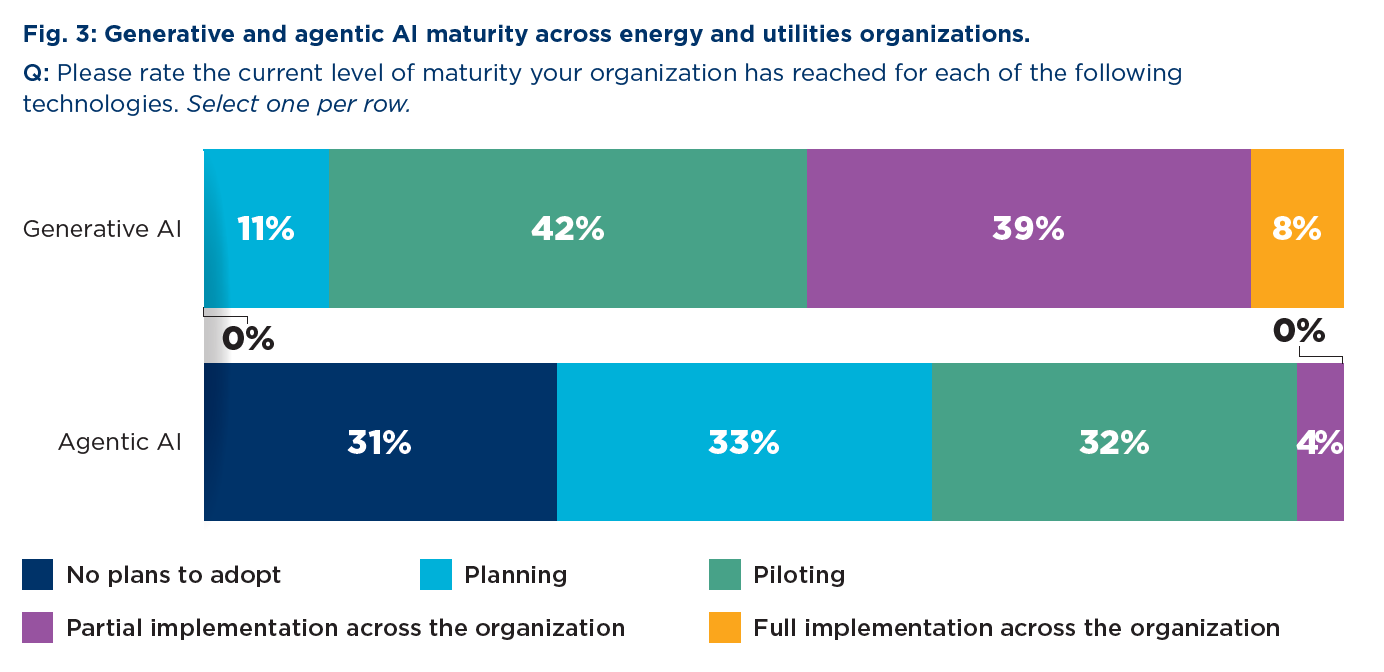
The study shows that energy and utilities firms are no longer experimenting at the margins. Many have moved beyond pilots and planning into phased implementation, with just under half of respondents saying generative AI has already been partially or fully implemented across their organizations. Still, maturity is uneven. Larger enterprises are further ahead, while midmarket firms remain earlier in the journey, and not a single midmarket respondent in the survey reported full implementation of generative AI. That matters in a sector where value often depends on coordination across operating units and service territories, whether the use case is outage communication, field-work planning, or reliability reporting. If implementation remains fragmented, enterprise-wide gains will stay limited.
The strongest use cases are where work is already structured and measurable
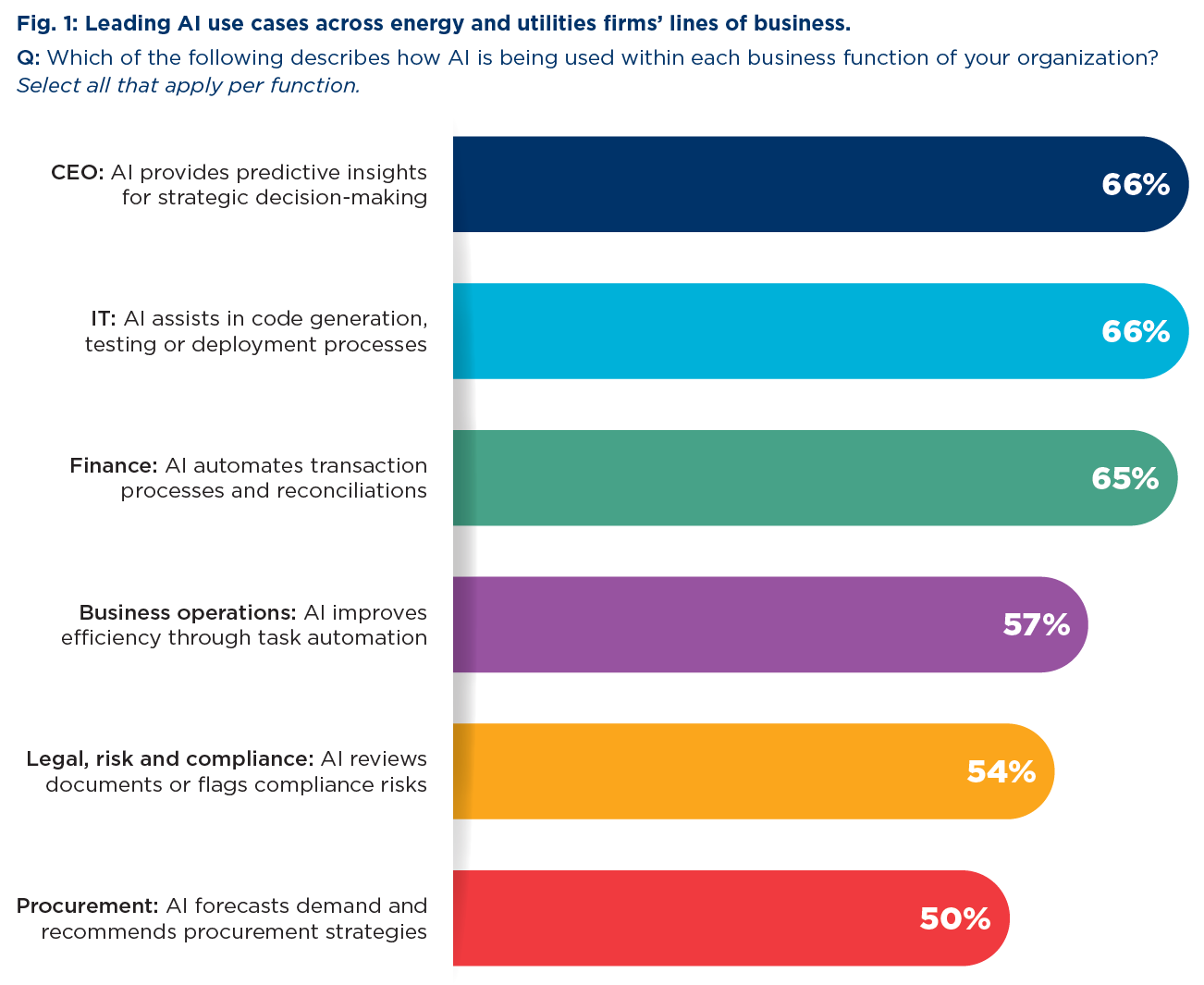
AI is reaching every line of business, but adoption is clearly strongest where workflows are already digitized, repeatable, and easier to measure. On average, leaders in the sector estimate that AI currently supports one in five tasks. The most mature use cases are in IT and business operations, where 66% report using AI to support coding, testing, or deployment, and 57% use it to automate operational tasks. Finance also shows relatively strong maturity in software automation and traditional machine learning, but more advanced AI remains less established there. That staged progression reflects the sector’s strong need for traceability, control, and auditability—especially in areas tied to financial and regulatory accountability.
The strongest early business results are in decision-making and customer engagement
The value story is already positive. More than nine in ten leaders say AI has improved speed of delivery, customer engagement, and innovation. The most significant gains are in insights and decision-making, where 44% report a significant improvement, and in customer engagement, where 42% say the same. These benefits are particularly visible in executive decision support: 66% say AI provides predictive insights for strategic decisions, while 59% use it for dashboards and reporting. In a sector shaped by storms, outages, shifting demand, and service expectations, that kind of faster insight has practical value well beyond productivity metrics.
Investment is real, but scaling will decide the real ROI story
Seven in ten leaders say their organizations have already made moderate or significant AI investments, with average current spending at $29 million. Forty-one percent describe their approach as strategic and coordinated rather than isolated or experimental. The average reported ROI today stands at 15%, and leaders expect it to rise to 29% within two years. That is an encouraging result, but the report makes it clear that better returns will not come from isolated pilots. To move from early wins to enterprise-wide value, organizations need repeatable deployments across operating units and priority workflows, not scattered experiments that stay local.
Data and integration are now the biggest barriers to progress
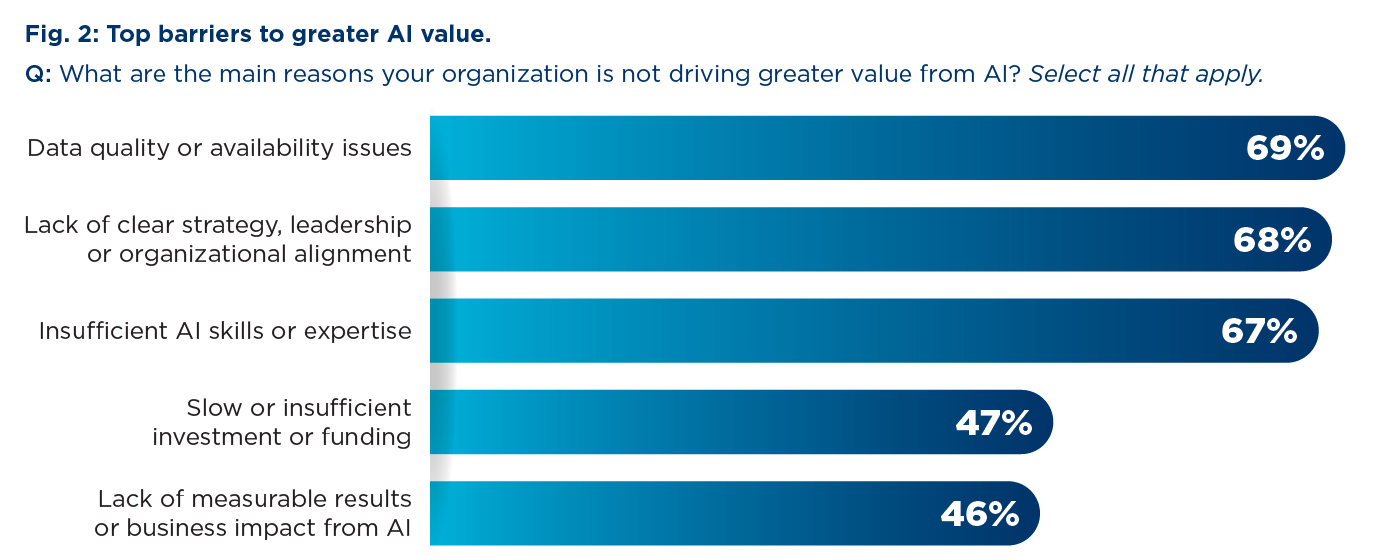
If there is one message that runs through the whole study, it is that data readiness now matters more than willingness to invest. Data quality or availability issues are cited by 69% of leaders as a top reason they are not driving greater value from AI. That is followed closely by a lack of clear strategy or organizational alignment at 68% and insufficient AI skills at 67%. The challenge is especially visible in regulated and governance-heavy functions: while seven in ten leaders believe their organization’s data is AI-ready overall, only 18% say the same for legal, risk, and compliance data, and only 28% say it for finance. The result is predictable: siloed, inconsistent data prevents firms from scaling AI across the cross-functional workflows where the biggest value usually sits.
Agentic AI is promising, but the sector is not ready at scale
The report treats agentic AI as the next frontier rather than the current standard. These more autonomous systems could eventually help coordinate complex, cross-system workflows in service operations, customer interactions, and IT. But maturity is still low. Agentic AI is the least mature layer across the sector, with only 4% reporting full implementation and 32% reporting partial implementation. Readiness is also mixed: more than a quarter of leaders say they are not prepared for AI agents, and preparedness is especially low in the midmarket, where only 15% of firms say they are mostly or fully prepared. This is not just a technology issue. It reflects the sector’s need for strong controls, reliable integration, lower technical debt, and practical operating models that can support more autonomy without reducing oversight.
What energy and utilities firms should do next
The conclusion is pragmatic rather than futuristic. The study recommends that firms rebalance AI programs toward stronger data and integration foundations, especially around operational technology, enterprise systems, and consistent master data for assets, locations, and customers. It also argues for scaling repeatable, measurable workflows first—especially those tied to reliability and customer-critical processes—so value becomes visible and sustainable across the organization. Only after that foundation is strengthened should organizations push more aggressively into agentic AI. In a sector where safety, resilience, and compliance cannot be compromised, long-term success will depend less on impressive pilots and more on disciplined adoption at scale.
Source: THE VALUE OF AI – Industry deep dive: Energy and utilities (Oxford Economics and SAP), 2025.
Interested in the article and want to know more? |