AudioCodes
con4PAS has become the AudioCodes Channel Partner with the certification:
Registered VAR / Systems Integrator

con4PAS has become the AudioCodes Channel Partner with the certification:
Registered VAR / Systems Integrator

Black Friday 2026 will test more than retailers' pricing and fulfilment capacity. Sinch's survey of 902 consumers in the United Kingdom, France, Germany and Spain shows that European shoppers will expect communication to match the task, the market and their individual preferences. They remain cautious about AI in general, but confidence rises when technology performs a clear and useful job.
European consumers are approaching Black Friday 2026 with mixed spending intentions. Across the four European markets in the study, 23% plan to spend more, close to the global average of 25%. The regional figure conceals substantial differences: 42% of shoppers in the United Kingdom expect to cut their spending, compared with 25% in France. Retailers therefore cannot treat Europe as one uniform audience. Communication will need to reflect both tighter budgets and the different ways in which customers in each market assess offers, channels and service.
Email remains the most consistent channel across Europe, but it does not remove the need for local choices. Fifty-four percent of European respondents want Black Friday promotions by email, while 72% prefer email for order updates. France is especially email-led, with 64% choosing it for promotional communication. Interest in interactive messaging varies much more widely, from 32% in Germany to 67% in Spain. Retailers should therefore manage communication preferences at customer level rather than apply one fixed channel mix across Europe.
The wider survey also shows that shoppers are becoming more selective about where each conversation takes place. The share wanting promotional messages across multiple channels has fallen from 78% in 2024 to 67% in 2026. For transactional communication, preference for multiple channels declined from 52% in 2025 to 49% in 2026. This does not mean that brands can simply reduce their channel portfolios. A customer may prefer email for an offer, SMS for an urgent delivery update, and a messaging app for support, so the operational challenge is to preserve context and preferences as the conversation moves.
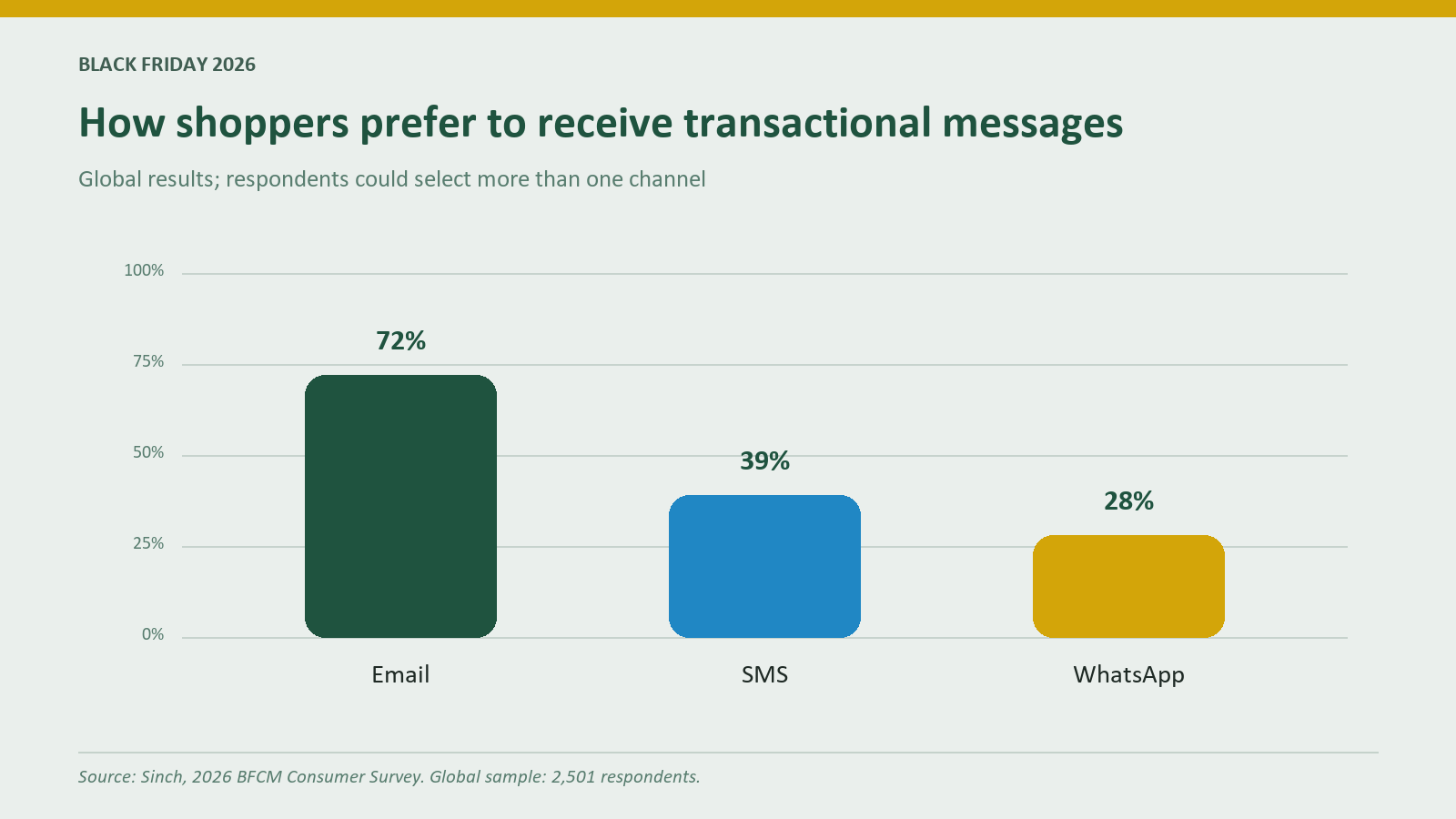
Black Friday will place the greatest pressure on communication after customer payment. Across the full survey, 75% expect an order confirmation within five minutes and 48% expect it immediately. At the same time, 93% consider it important to respond to or interact with post-purchase messages, and 61% describe that capability as very important. A delivery notification that cannot accept a question, confirm receipt, or support a change of delivery time will often move the customer into another channel or into a support queue. Retailers should therefore plan transactional messaging as a two-way service, with sufficient capacity for the volume peaks expected around Black Friday.
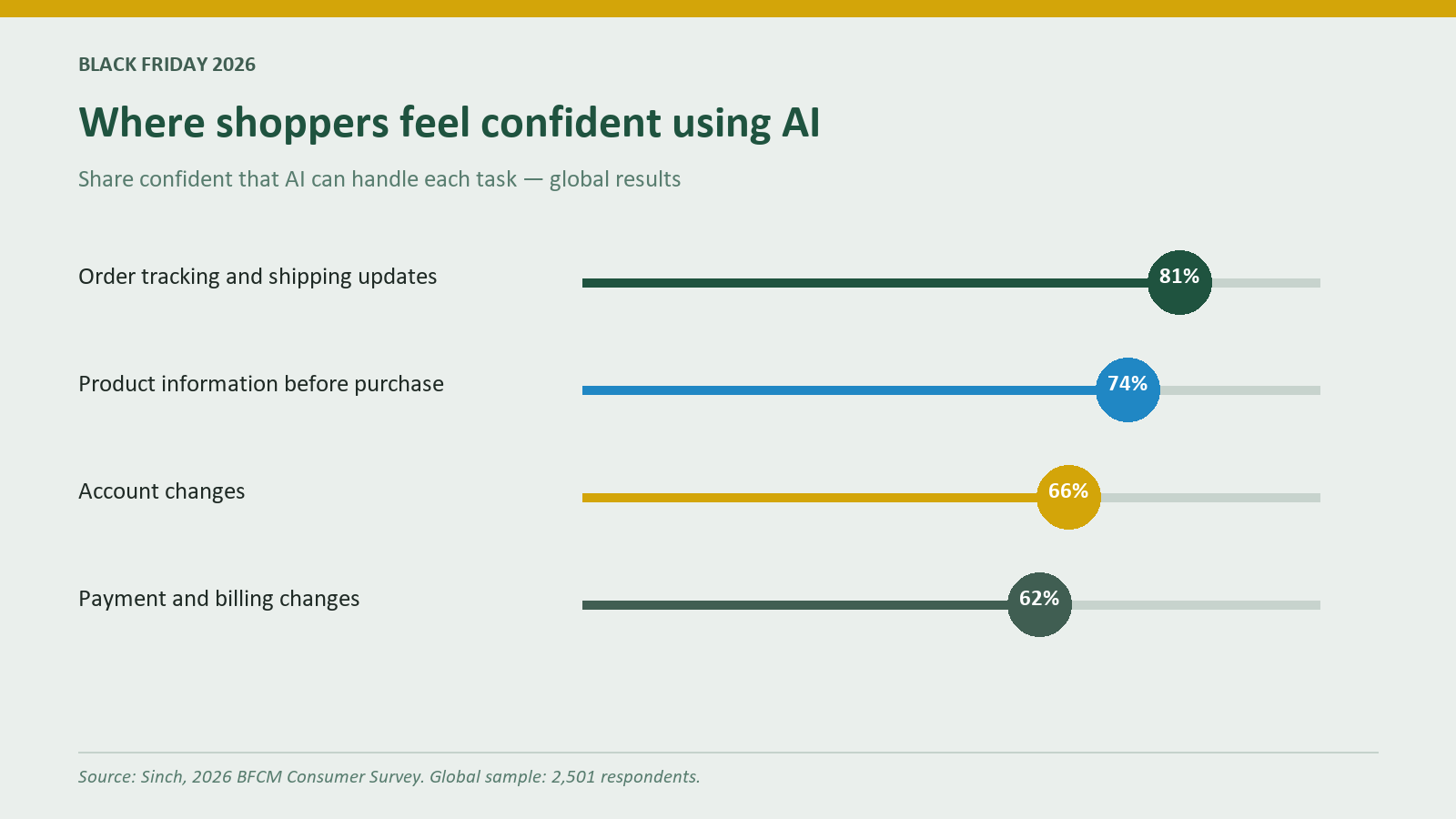
European attitudes to AI are cautious but not dismissive. Thirty-nine percent of European respondents believe AI will make Black Friday shopping easier, and 49% would engage with interactive messaging. The global results show why the purpose of the interaction matters. Confidence reaches 81% when AI handles order tracking and shipping updates and 74% when it answers questions about a product before purchase. It falls to 66% for account changes and 62% for payment or billing changes. Shoppers appear ready to delegate routine information tasks while expecting more control when an interaction affects their identity, account, or money.
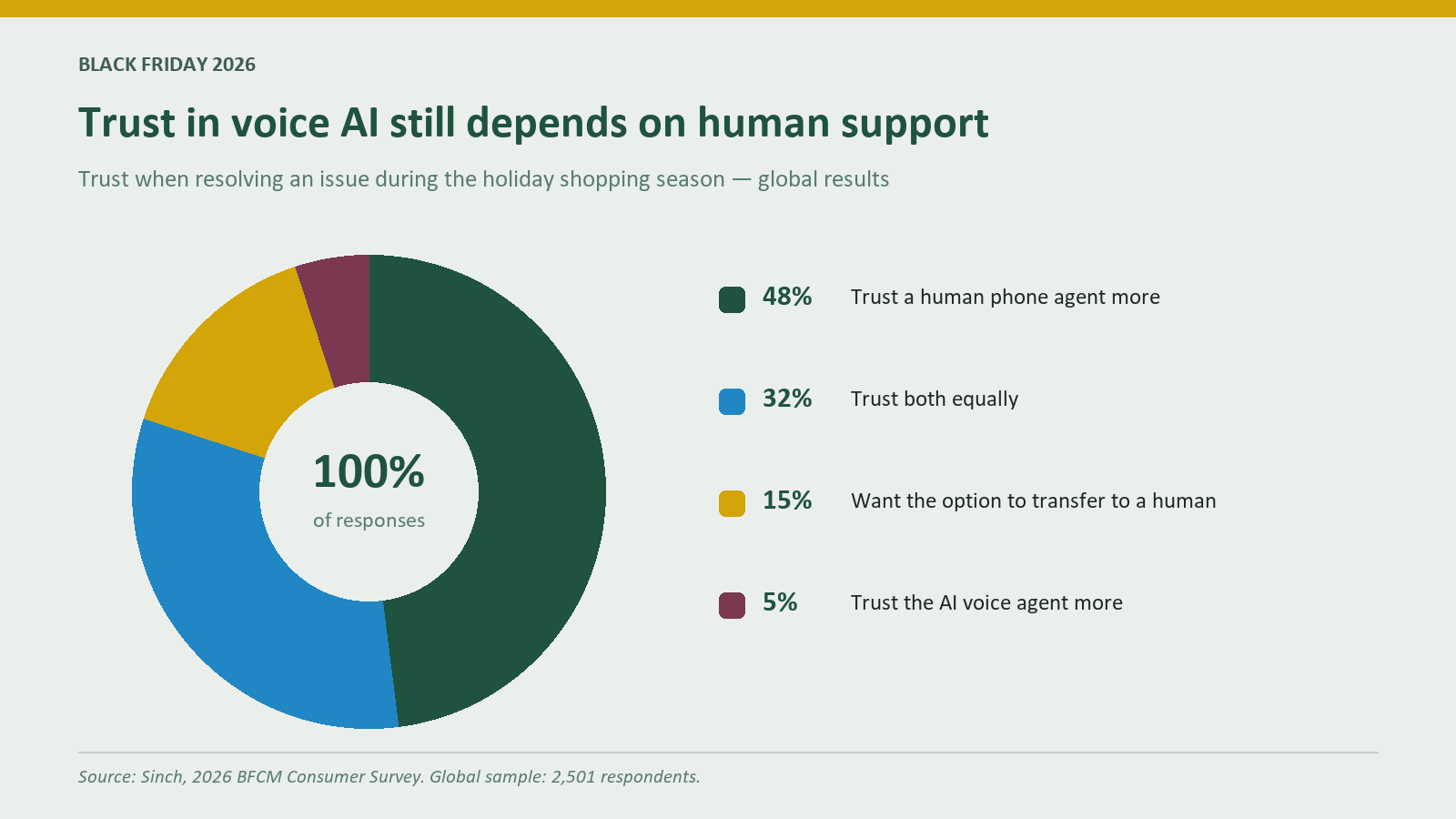
Europe records the greatest concern about AI transparency among the regions in the study. Nineteen percent of European shoppers identify not knowing whether they are speaking to a human as their main AI concern. Across the full sample, privacy and data use rank first at 43%, while 53% trust a person's product recommendation more than an AI recommendation. Voice interactions show a similar need for choice: 48% trust a human phone agent more, 32% trust both equally, and 15% want the option to transfer to a person. Clear disclosure and an effective handoff are therefore part of the service design, especially when the request is sensitive or the automated response is insufficient.
For Black Friday 2026, retailers need a communication environment that retains customer context and uses it to select the right channel for each step. That requires reliable transactional delivery, shared preference data, and continuity between automated and human service. AI can support this model when each use case has a clear purpose and a defined route to human assistance. European retailers should use the period before Black Friday to test these connections under realistic volumes and to confirm that customers can understand, answer, and act on every important message.
Source: Sinch, Black Friday trends 2026: What 2,501 shoppers want from customer communications
Interested in the article and want to know more? |