AudioCodes
con4PAS has become the AudioCodes Channel Partner with the certification:
Registered VAR / Systems Integrator

con4PAS has become the AudioCodes Channel Partner with the certification:
Registered VAR / Systems Integrator

A customer asks where their order is. AI can draft a polite reply, but it needs access to business data to find out the order's status. Sending an update also requires a communication tool. Model Context Protocol, or MCP, makes it easier to connect AI to this data and these tools. What does that mean, and how can businesses use it?
We initially used generative AI to write text, summarise documents and find answers. At work, though, another need soon becomes clear: we want our assistant to know what is happening in the business. Unless we give it the relevant information or connect it to the right system, it cannot see an order's status or the latest exchange with a customer. Connections between AI applications and other systems were often built individually. In November 2024, Anthropic introduced MCP as an open standard: a shared set of rules for making these connections.
Think of MCP as a common connector. On one side is the AI application we talk to; on the other, a customer relationship management system, or CRM, for example. An MCP server links the two. We can consider it an adapter that offers the application selected capabilities, such as finding a customer or checking the status of a request. Here, "server" means a program or service, rather than necessarily another computer. Someone still needs to set up the connection, but the common interface allows different compatible AI applications to use it. MCP makes existing business capabilities accessible to AI.
This is where AI agents come in. An agent selects tools in response to a task and works through it step by step. For an order enquiry, it might check the status, prepare a reply, and send a message once any required approval has been given. The language model helps interpret the request and suggest a sequence of steps; the AI application manages those steps according to its rules. MCP provides a common way for the application and its adapters to exchange available capabilities, requests, and results. The protocol itself does not decide what the agent should do.
Sinch is one example. Its MCP server provides tools for messaging, email, voice services, and verification. Sinch also offers Docs MCP, which gives AI coding tools access to documentation. The distinction has practical consequences: documentation tells an assistant how to use a service, while a communication tool allows it to send a message. A business therefore needs to distinguish between AI retrieving information and AI acting on its behalf.
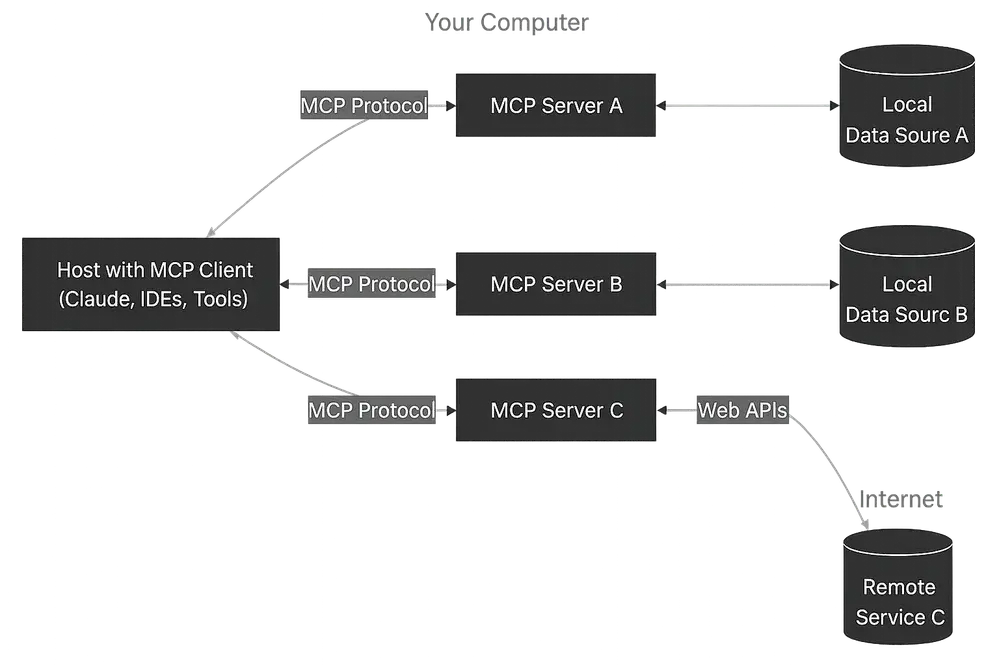
How MCP connects an AI application to data and services. Source: Sinch blog, referencing Model Context Protocol.
Sinch's examples include sending a tracking number when an order ships and making a reminder call before an appointment. For the order, we can imagine the following workflow. An agent retrieves the dispatch confirmation and tracking number from the order management system. It prepares an update and requests delivery through a Sinch communication tool. Each part has a clear role: the business system supplies the data, the AI application puts the steps together, and the communication service delivers the message. MCP makes it easier to connect these parts.
A more complex scenario involves a financial institution using an agent to communicate with customers about outstanding loans and help coordinate a repayment plan. This illustrates a possible use, rather than a documented customer deployment. It also shows where responsibility lies. The tool enables communication, but repayment terms must follow the institution's rules. The order example requires similar decisions about the recipient, permitted content, and timing of the message.
A sensible starting point is a single task with a clear outcome, such as notifying a customer that their request has been resolved. We define where the agent may obtain data, what it may do independently, and when it needs human approval. We then measure whether it saves time, how often it makes mistakes, and how frequently staff need to intervene. MCP includes security rules, but applying them correctly depends on the application and adapter. Running an adapter locally does not guarantee that retrieved data stays on the computer: the AI application may send it to a remote model.

The MCP roadmap includes work on agent identity and delegated permissions. In practical terms, systems need to know on whose behalf an agent is acting and what it is allowed to do. These are areas of development, rather than promises of completed features. Business leaders still need to choose a useful process and assign someone responsibility for its outcome. As AI becomes more autonomous, managing its permissions will require as much attention as managing its capabilities.
In Part 2, "How MCP works in practice, step by step", we will follow a simple task involving a file. We will explain what the application and adapter exchange, what happens during an outage, and why the number of tools and correctly configured permissions matter.
Jan Ferjo
Business Development Director, con4PAS
Sources:
Anthropic – Introducing the Model Context Protocol, 25 November 2024
MCP – introduction to the standard
MCP – specification and security principles
Sinch – MCP Server and Docs MCP
Sinch – Using the Sinch MCP Server
Sinch – announcement of its MCP implementation, 16 July 2025
MCP – roadmap, updated 22 August 2026
Interested in the article and want to know more? |